
Hip pain can significantly impact mobility, independence, and overall quality of life. Conditions such as hip fractures, arthritis, joint degeneration, and age-related wear and tear can make everyday activities like walking, climbing stairs, or even standing extremely difficult.
When conservative treatments such as medications, physiotherapy, and lifestyle modifications fail to provide relief, Hip Replacement Surgery may be recommended. Among the available options, Partial Hip Replacement is a highly effective procedure for selected patients, particularly elderly individuals with hip fractures or localized joint damage.
India has become a leading destination for hip replacement surgery, offering internationally trained orthopedic surgeons, advanced surgical technology, high-quality implants, and affordable treatment costs.
At Mufa Meditourism, we help international patients access India's leading orthopedic hospitals and specialists while providing complete medical travel support throughout the treatment journey.
What Is Partial Hip Replacement?
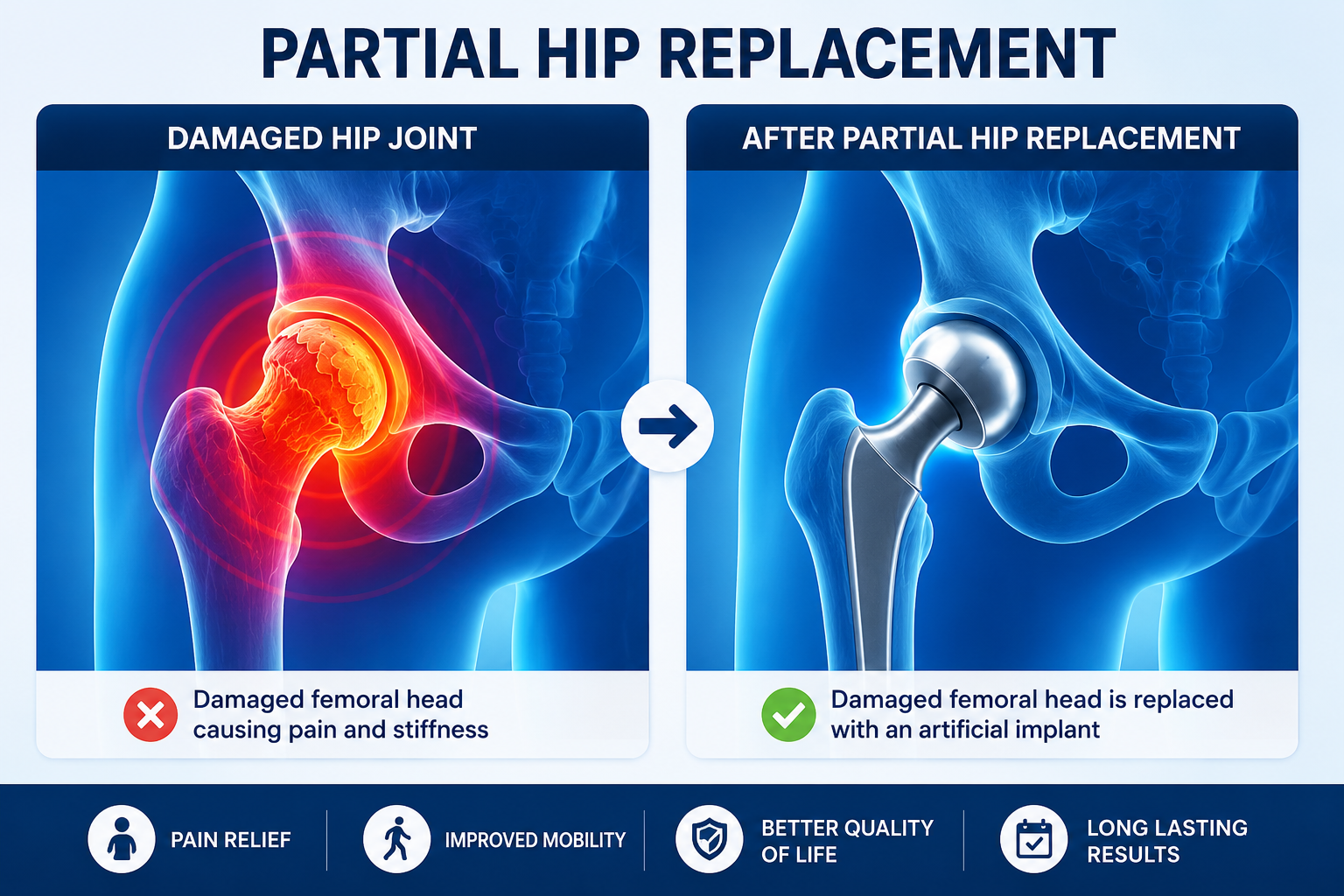
Partial Hip Replacement, also known as Hemiarthroplasty, is a surgical procedure in which only the damaged femoral head (the ball portion of the hip joint) is replaced with an artificial implant.
Unlike Total Hip Replacement, where both the ball and socket of the hip joint are replaced, Partial Hip Replacement preserves the natural hip socket while replacing only the affected portion of the joint.
This procedure is commonly recommended for patients with specific types of hip fractures and localized damage.
Understanding the Hip Joint
The hip is a ball-and-socket joint consisting of:
- Femoral Head (Ball)
- Acetabulum (Socket)
- Cartilage
- Ligaments
- Muscles
A healthy hip allows smooth movement and supports body weight during daily activities.
When injury, arthritis, or degeneration damages the joint, pain and mobility limitations can occur.
Conditions That May Require Partial Hip Replacement
Hip Fractures
The most common reason for Partial Hip Replacement is a fractured femoral neck, particularly in elderly patients.
Localized Joint Damage
When damage is limited primarily to the femoral head and the socket remains healthy, partial replacement may be sufficient.
Avascular Necrosis
This condition occurs when blood supply to the femoral head is disrupted, causing bone tissue death.
Certain Traumatic Injuries
Severe trauma affecting the ball portion of the hip joint may require surgical replacement.
Types of Hip Replacement Surgery
Partial Hip Replacement (Hemiarthroplasty)
Only the femoral head is replaced while preserving the natural socket.
Total Hip Replacement (THR)
Both the femoral head and acetabulum are replaced with artificial components.
Hip Resurfacing
A bone-preserving procedure often considered for younger and highly active patients.
Revision Hip Replacement
Performed when a previous hip implant becomes worn, loose, or damaged.
Latest Advances in Hip Replacement Surgery
Orthopedic surgery has evolved dramatically over the last decade.
Robotic-Assisted Hip Replacement
Robotic systems help surgeons achieve greater precision during implant positioning.
Benefits include:
- Improved Accuracy
- Better Implant Alignment
- Reduced Soft Tissue Damage
- Faster Recovery
Minimally Invasive Hip Surgery
Modern surgical approaches use smaller incisions, resulting in:
- Less Pain
- Reduced Blood Loss
- Faster Healing
- Shorter Hospital Stay
Advanced Implant Materials
Today's implants are manufactured using highly durable materials such as:
- Titanium Alloys
- Ceramic Components
- Highly Cross-Linked Polyethylene
These materials improve longevity and reduce wear.
3D Surgical Planning
Advanced imaging technology allows surgeons to create personalized treatment plans based on the patient's anatomy.
Enhanced Recovery Protocols
Modern rehabilitation programs help patients mobilize sooner and achieve faster functional recovery.
Benefits of Partial Hip Replacement
Pain Relief
One of the primary benefits is significant reduction or elimination of hip pain.
Improved Mobility
Patients often regain the ability to walk, stand, and perform daily activities more comfortably.
Faster Recovery
Because only part of the joint is replaced, recovery may be faster in selected patients.
Reduced Surgical Time
Partial replacement procedures are often shorter than total hip replacement surgeries.
Improved Quality of Life
Many patients experience greater independence and improved overall well-being after surgery.
Success Rate of Hip Replacement Surgery
Hip replacement surgery is considered one of the most successful orthopedic procedures worldwide.
Studies show:
- More than 90% of patients experience significant pain relief.
- Most implants function effectively for 15 to 25 years or longer.
- Modern surgical techniques continue to improve long-term outcomes.
Patient satisfaction rates remain exceptionally high due to improved mobility and quality of life.
Recovery After Partial Hip Replacement
Hospital Stay
Most patients remain hospitalized for approximately 3 to 5 days.
Early Mobilization
Walking often begins within 24 hours after surgery with the assistance of physiotherapists.
Rehabilitation
Physical therapy focuses on:
- Strength Building
- Balance Training
- Joint Mobility
- Walking Techniques
Return to Daily Activities
Many patients resume routine activities within several weeks, although full recovery may take a few months.
Why Choose India for Partial Hip Replacement Surgery?
India has become one of the world's preferred destinations for orthopedic surgery because of:
Highly Experienced Orthopedic Surgeons
Many specialists have extensive experience performing complex joint replacement procedures.
Advanced Medical Technology
Leading hospitals offer:
- Robotic-Assisted Surgery
- Computer Navigation Systems
- Advanced Imaging Technology
- Minimally Invasive Surgical Techniques
Affordable Treatment Costs
Patients can save 50–70% compared to treatment costs in the USA, UK, Europe, and many other countries.
Comprehensive International Patient Services
Hospitals provide support with:
- Medical Visas
- Travel Planning
- Accommodation
- Airport Transfers
- Language Assistance
How Mufa Meditourism Supports International Patients
At Mufa Meditourism, we help patients access India's leading orthopedic surgeons and hip replacement centers.
Medical Report Evaluation
Our team reviews medical records and connects patients with the most suitable specialists.
Hospital and Surgeon Selection
We help identify the best hospital and treatment plan based on individual needs.
Travel and Visa Assistance
We assist with:
- Medical Visa Applications
- Airport Transfers
- Accommodation Arrangements
- Local Transportation
End-to-End Patient Coordination
From consultation to recovery, our coordinators remain available throughout the treatment journey.
Conclusion
Partial Hip Replacement is an effective and proven solution for patients suffering from hip fractures and localized joint damage. With advancements such as robotic-assisted surgery, minimally invasive techniques, customized implants, and enhanced rehabilitation programs, patients today benefit from safer procedures and faster recovery than ever before.
India offers world-class orthopedic care through experienced surgeons, advanced technology, and affordable treatment costs. Through Mufa Meditourism, international patients can confidently access high-quality hip replacement treatment while receiving comprehensive support every step of the way.