
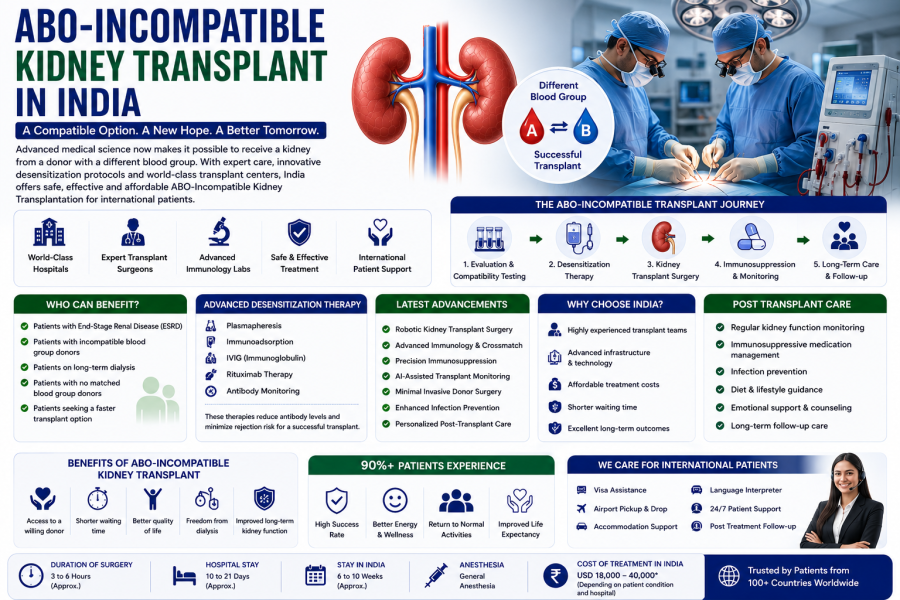
1 to 3 weeks before surgery. Kidney transplant surgery usually takes 3 to 6 hours.
10 to 21 days in the hospital depending on recovery, antibody levels, and post-transplant monitoring. Duration of Stay in India 2-3 Months
General anesthesia is used during kidney transplant surgery
18,000 to 25,000 USD*
An ABO-Incompatible (ABOi) Kidney Transplant is an advanced kidney transplant procedure that allows a patient to receive a kidney from a donor with a different blood group. Traditionally, kidney transplantation required both donor and recipient to have compatible blood types. However, with modern medical advancements, patients who previously had limited transplant options can now successfully undergo transplantation despite blood group incompatibility.
India has emerged as one of the leading destinations for ABO-Incompatible Kidney Transplant surgery due to its experienced transplant teams, advanced immunology laboratories, modern transplant centers, and affordable treatment costs. Many international patients choose India because of its world-class transplant programs, shorter waiting times, and significantly lower costs compared to Western countries.
Recent advancements in transplant medicine have made ABO-Incompatible Kidney Transplants safer and more successful than ever before. Leading hospitals now use advanced desensitization protocols, plasmapheresis, immunoadsorption therapy, Rituximab-based treatment, precision immunosuppression, AI-assisted transplant monitoring, and sophisticated tissue matching technologies. These innovations help reduce rejection risks and improve long-term transplant outcomes.
For patients with kidney failure who have a willing donor but incompatible blood groups, ABO-Incompatible Kidney Transplantation offers a valuable opportunity to receive a life-saving transplant without waiting years for a compatible donor.
Patients who may require an ABO-Incompatible Kidney Transplant often suffer from:
Conditions commonly leading to kidney transplantation include:
Patients with an available donor but incompatible blood group are potential candidates for ABO-Incompatible transplantation.
Before the transplant procedure, both donor and recipient undergo extensive medical evaluation.
Diagnostic tests may include:
A personalized desensitization plan is created to reduce blood group antibodies before transplantation.
The donor undergoes a detailed health assessment to ensure suitability and safety.
The transplant team evaluates the patient's overall health, kidney condition, and transplant readiness.
One of the most important steps in ABO-Incompatible transplantation.
This may include:
These treatments help lower blood group antibodies and reduce rejection risk.
Specialized laboratory testing is performed throughout treatment to ensure antibody levels remain within safe limits.
The healthy donor kidney is transplanted into the recipient and connected to blood vessels and the urinary system.
Some leading centers offer robotic transplant surgery, providing greater precision, reduced blood loss, smaller incisions, and faster recovery.
Advanced personalized medication protocols help protect the transplanted kidney from rejection.
Recovery and monitoring are extremely important after an ABO-Incompatible transplant.
Post-transplant care includes:
Patients receive individualized care plans to support long-term graft function.
Modern medical advancements have transformed ABO-Incompatible Kidney Transplantation into a highly effective treatment option for patients who previously had limited transplant opportunities.
Today, many patients successfully receive kidneys from donors with different blood groups and experience significant improvements in quality of life. Most patients can return to work, family life, travel, and normal daily activities without depending on regular dialysis.
India's leading transplant centers utilize advanced desensitization protocols, precision immunosuppression, and comprehensive post-transplant monitoring programs that help improve long-term kidney function and patient well-being.
The success of transplantation depends on donor compatibility, antibody management, adherence to medications, regular follow-up care, and overall patient health.
Patients who may require an ABO-Incompatible Kidney Transplant often suffer from:
Conditions commonly leading to kidney transplantation include:
Patients with an available donor but incompatible blood group are potential candidates for ABO-Incompatible transplantation.
Before the transplant procedure, both donor and recipient undergo extensive medical evaluation.
Diagnostic tests may include:
A personalized desensitization plan is created to reduce blood group antibodies before transplantation.
The donor undergoes a detailed health assessment to ensure suitability and safety.
The transplant team evaluates the patient's overall health, kidney condition, and transplant readiness.
One of the most important steps in ABO-Incompatible transplantation.
This may include:
These treatments help lower blood group antibodies and reduce rejection risk.
Specialized laboratory testing is performed throughout treatment to ensure antibody levels remain within safe limits.
The healthy donor kidney is transplanted into the recipient and connected to blood vessels and the urinary system.
Some leading centers offer robotic transplant surgery, providing greater precision, reduced blood loss, smaller incisions, and faster recovery.
Advanced personalized medication protocols help protect the transplanted kidney from rejection.
Recovery and monitoring are extremely important after an ABO-Incompatible transplant.
Post-transplant care includes:
Patients receive individualized care plans to support long-term graft function.
Modern medical advancements have transformed ABO-Incompatible Kidney Transplantation into a highly effective treatment option for patients who previously had limited transplant opportunities.
Today, many patients successfully receive kidneys from donors with different blood groups and experience significant improvements in quality of life. Most patients can return to work, family life, travel, and normal daily activities without depending on regular dialysis.
India's leading transplant centers utilize advanced desensitization protocols, precision immunosuppression, and comprehensive post-transplant monitoring programs that help improve long-term kidney function and patient well-being.
The success of transplantation depends on donor compatibility, antibody management, adherence to medications, regular follow-up care, and overall patient health.
It is a kidney transplant performed between a donor and recipient with different blood groups using specialized treatments to reduce rejection risk.
Yes. With modern desensitization therapies and experienced transplant teams, ABO-Incompatible transplantation is now considered a safe and effective treatment option.
Recent advancements include plasmapheresis, immunoadsorption therapy, Rituximab treatment, precision immunosuppression, AI-assisted monitoring, and advanced antibody testing.
Yes. India is internationally recognized for advanced transplant programs, experienced surgeons, modern immunology laboratories, and affordable treatment costs.
Not necessarily. ABO-Incompatible transplantation allows eligible patients to receive kidneys from donors with different blood groups.
Yes. International patients receive assistance with medical visas, accommodation, airport transfers, interpreters, and post-transplant follow-up.

Rockland Qutab, South Delhi, B 33- 34,Qutub Institutional Area, Katwaria Sarai – New Delhi

Sector 51 Gurgaon, Haryana 122 017, INDIA

Sector – 44, Opposite HUDA City Centre, Gurgaon, Haryana – 122002, India

Sarita Vihar, Mathura Road, New Delhi – 110076 , INDIA