
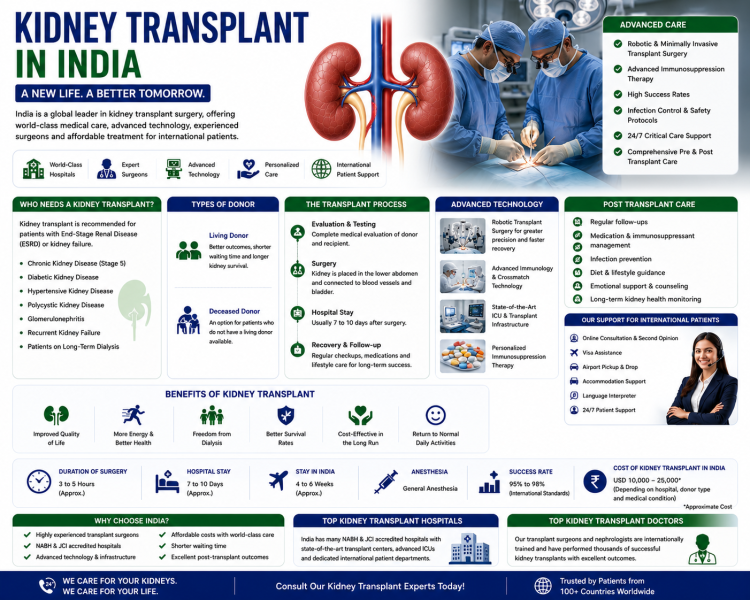
Kidney transplant surgery generally takes 3 to 5 hours, depending on the complexity of the procedure and the patient's medical condition.
Patients usually stay 7 to 14 days in the hospital for surgery, monitoring, and recovery.
General anesthesia is administered during kidney transplant surgery.
12,000 to 20,000 USD*
A kidney transplant is considered the most effective long-term treatment for patients with End-Stage Renal Disease (ESRD) and irreversible kidney failure. During the procedure, a healthy kidney from a living or deceased donor is transplanted into the patient, allowing the body to regain normal kidney function. Unlike lifelong dialysis, a successful kidney transplant enables patients to enjoy greater independence, improved health, and a significantly better quality of life.
India has established itself as one of the most trusted destinations for kidney transplantation, attracting thousands of international patients every year from Africa, the Middle East, and other parts of the world. The country is known for its highly skilled transplant surgeons, internationally accredited hospitals, advanced transplant programs, and affordable treatment costs. Patients also benefit from shorter waiting times, multidisciplinary transplant teams, and comprehensive medical tourism services.
Over the last decade, kidney transplantation has witnessed remarkable advancements. Leading transplant centers in India now utilize robotic-assisted kidney transplantation, 3D CT angiography for surgical planning, next-generation HLA typing, virtual crossmatch technology, high-sensitivity donor-specific antibody (DSA) testing, desensitization protocols for high-risk recipients, AI-assisted transplant monitoring, precision immunosuppressive therapy, minimally invasive donor nephrectomy, and remote post-transplant follow-up systems. These innovations have improved transplant safety, reduced rejection rates, minimized complications, and enhanced long-term graft survival.
Whether you are living with chronic kidney disease, kidney failure, or undergoing regular dialysis, India offers advanced kidney transplant solutions supported by international standards of safety, ethics, and patient care.
A Blood Group Compatible Kidney Transplant is performed when the donor and recipient have compatible ABO blood groups and acceptable tissue matching. This is the most common type of kidney transplant and generally requires less pre-transplant preparation. After completing compatibility testing, the transplant surgery can usually be scheduled without the need for specialized antibody-reduction therapy.
Compatible kidney transplants generally have excellent long-term outcomes when combined with experienced surgical care, appropriate immunosuppressive medications, and regular follow-up. Patients often experience faster preparation, lower treatment complexity, and excellent graft function.
An ABO-Incompatible (ABOi) Kidney Transplant allows a patient to receive a kidney from a donor with a different blood group. Thanks to major advancements in transplant medicine, blood group incompatibility is no longer considered an absolute barrier to kidney transplantation.
Before surgery, the recipient undergoes a specialized desensitization program to reduce blood group antibodies that could attack the transplanted kidney. Depending on the patient's condition, treatment may include:
Leading transplant hospitals in India have dedicated transplant immunology laboratories and experienced multidisciplinary teams that successfully perform ABO-Incompatible Kidney Transplants with excellent clinical outcomes. This advanced treatment provides a life-saving option for patients who have a willing donor but incompatible blood groups.
If a living donor is healthy but not compatible with the recipient due to blood group or tissue mismatch, a Kidney Paired Donation (KPD), also known as a Swap Transplant, may be considered where permitted by law. In this program, two or more incompatible donor-recipient pairs exchange compatible kidneys, allowing multiple patients to receive successful transplants while maintaining donor safety and compatibility.
Kidney transplantation may become necessary due to:
Proper management of these conditions can delay disease progression, but transplantation remains the preferred long-term treatment for advanced kidney failure.
Before kidney transplantation, both the donor and recipient undergo detailed medical evaluation to ensure the highest level of safety and compatibility.
Pre-transplant investigations may include:
International patients can submit their medical records online to receive an expert opinion and preliminary treatment plan before travelling to India.
The transplant procedure is carefully planned and performed by a multidisciplinary transplant team.
A healthy living or deceased donor kidney is assessed through comprehensive medical, surgical, and immunological evaluation.
The recipient undergoes a complete health assessment to confirm suitability for transplantation and optimize medical condition before surgery.
The donor kidney is transplanted into the lower abdomen and connected to the recipient's blood vessels and urinary bladder while the patient's original kidneys usually remain in place unless medically indicated.
Living donor transplantation provides shorter waiting times, better long-term kidney function, and excellent clinical outcomes.
Patients without a suitable living donor may undergo transplantation using a deceased donor kidney according to established transplant regulations.
Advanced robotic technology enables surgeons to perform transplantation with greater precision, smaller incisions, reduced blood loss, less postoperative pain, and faster recovery in selected patients.
Modern laparoscopic and robotic donor surgery helps healthy donors recover more quickly with minimal discomfort and excellent cosmetic results.
Personalized medication protocols are designed according to each patient's immune profile to minimize rejection while reducing medication-related side effects.
After transplantation, close monitoring helps ensure healthy kidney function and early detection of any complications.
Post-transplant care includes:
Comprehensive follow-up care plays a vital role in maintaining the health of the transplanted kidney.
A successful kidney transplant offers patients the opportunity to regain their independence and enjoy a healthier, more active life. Most patients experience improved energy levels, better appetite, enhanced physical activity, and freedom from routine dialysis.
India's leading transplant centers combine advanced surgical techniques, evidence-based immunosuppressive therapy, and long-term transplant monitoring to help patients achieve excellent clinical outcomes. Many international patients return home within a few weeks after surgery and continue follow-up care through online consultations and coordinated communication with their local physicians.
Long-term transplant success depends on medication adherence, regular medical follow-up, healthy lifestyle choices, infection prevention, and ongoing monitoring by experienced transplant specialists.
Patients who may be candidates for kidney transplantation often experience:
Patients with advanced kidney disease should undergo a transplant evaluation as early as possible.
Kidney transplantation may become necessary due to:
Proper management of these conditions can delay disease progression, but transplantation remains the preferred long-term treatment for advanced kidney failure.
Before kidney transplantation, both the donor and recipient undergo detailed medical evaluation to ensure the highest level of safety and compatibility.
Pre-transplant investigations may include:
International patients can submit their medical records online to receive an expert opinion and preliminary treatment plan before travelling to India.
The transplant procedure is carefully planned and performed by a multidisciplinary transplant team.
A healthy living or deceased donor kidney is assessed through comprehensive medical, surgical, and immunological evaluation.
The recipient undergoes a complete health assessment to confirm suitability for transplantation and optimize medical condition before surgery.
The donor kidney is transplanted into the lower abdomen and connected to the recipient's blood vessels and urinary bladder while the patient's original kidneys usually remain in place unless medically indicated.
Living donor transplantation provides shorter waiting times, better long-term kidney function, and excellent clinical outcomes.
Patients without a suitable living donor may undergo transplantation using a deceased donor kidney according to established transplant regulations.
Advanced robotic technology enables surgeons to perform transplantation with greater precision, smaller incisions, reduced blood loss, less postoperative pain, and faster recovery in selected patients.
Modern laparoscopic and robotic donor surgery helps healthy donors recover more quickly with minimal discomfort and excellent cosmetic results.
Personalized medication protocols are designed according to each patient's immune profile to minimize rejection while reducing medication-related side effects.
After transplantation, close monitoring helps ensure healthy kidney function and early detection of any complications.
Post-transplant care includes:
Comprehensive follow-up care plays a vital role in maintaining the health of the transplanted kidney.
A successful kidney transplant offers patients the opportunity to regain their independence and enjoy a healthier, more active life. Most patients experience improved energy levels, better appetite, enhanced physical activity, and freedom from routine dialysis.
India's leading transplant centers combine advanced surgical techniques, evidence-based immunosuppressive therapy, and long-term transplant monitoring to help patients achieve excellent clinical outcomes. Many international patients return home within a few weeks after surgery and continue follow-up care through online consultations and coordinated communication with their local physicians.
Long-term transplant success depends on medication adherence, regular medical follow-up, healthy lifestyle choices, infection prevention, and ongoing monitoring by experienced transplant specialists.
Yes. Kidney transplantation in India is significantly more affordable than in many developed countries while maintaining international standards of quality and patient safety.
Patients with advanced kidney failure or End-Stage Renal Disease who meet medical eligibility criteria may be considered for transplantation after a comprehensive evaluation.
Recent advancements include robotic-assisted kidney transplantation, AI-assisted transplant monitoring, next-generation HLA typing, virtual crossmatching, high-sensitivity antibody testing, precision immunosuppression, minimally invasive donor nephrectomy, and remote post-transplant monitoring.
Yes. Eligible international patients can undergo kidney transplantation in India after fulfilling the legal, ethical, and medical requirements applicable to donor-recipient relationships and documentation.
The lifespan of a transplanted kidney varies depending on donor type, overall health, medication adherence, and long-term follow-up. Many transplanted kidneys function successfully for many years.
Yes. International patients receive comprehensive assistance with treatment planning, medical visas, airport transfers, accommodation, language interpretation, and long-term follow-up.

Rockland Qutab, South Delhi, B 33- 34,Qutub Institutional Area, Katwaria Sarai – New Delhi

Sector 51 Gurgaon, Haryana 122 017, INDIA

Sector – 44, Opposite HUDA City Centre, Gurgaon, Haryana – 122002, India

Sarita Vihar, Mathura Road, New Delhi – 110076 , INDIA